

Boris Herrmann’s New Weapon: Malizia 4 Is Much More Than Just a great looking New IMOCA
There are boat launches, and then there are moments when a whole class suddenly shows you where it is going.
Boris Herrmann’s new Malizia 4 touching the water in Lorient is very much the second kind.
Of course, because it is Boris Herrmann, the internet immediately had its moment. The black-and-red livery. The Monaco red foils and appendages. The clean aggressive lines. The usual Team Malizia polish. The calm German confidence. The handsome skipper standing next to a new ocean weapon.
Yes, yes. We all saw it. But underneath all of that very nice branding, there is a far more interesting story.
Because Malizia 4 is not just a new boat. It is a direct answer to the strengths and weaknesses of the previous Malizia. It is Team Malizia saying: we know exactly what our last boat did brilliantly, we know where it suffered, and now we are trying to build the version that keeps the monster alive while removing the penalty.
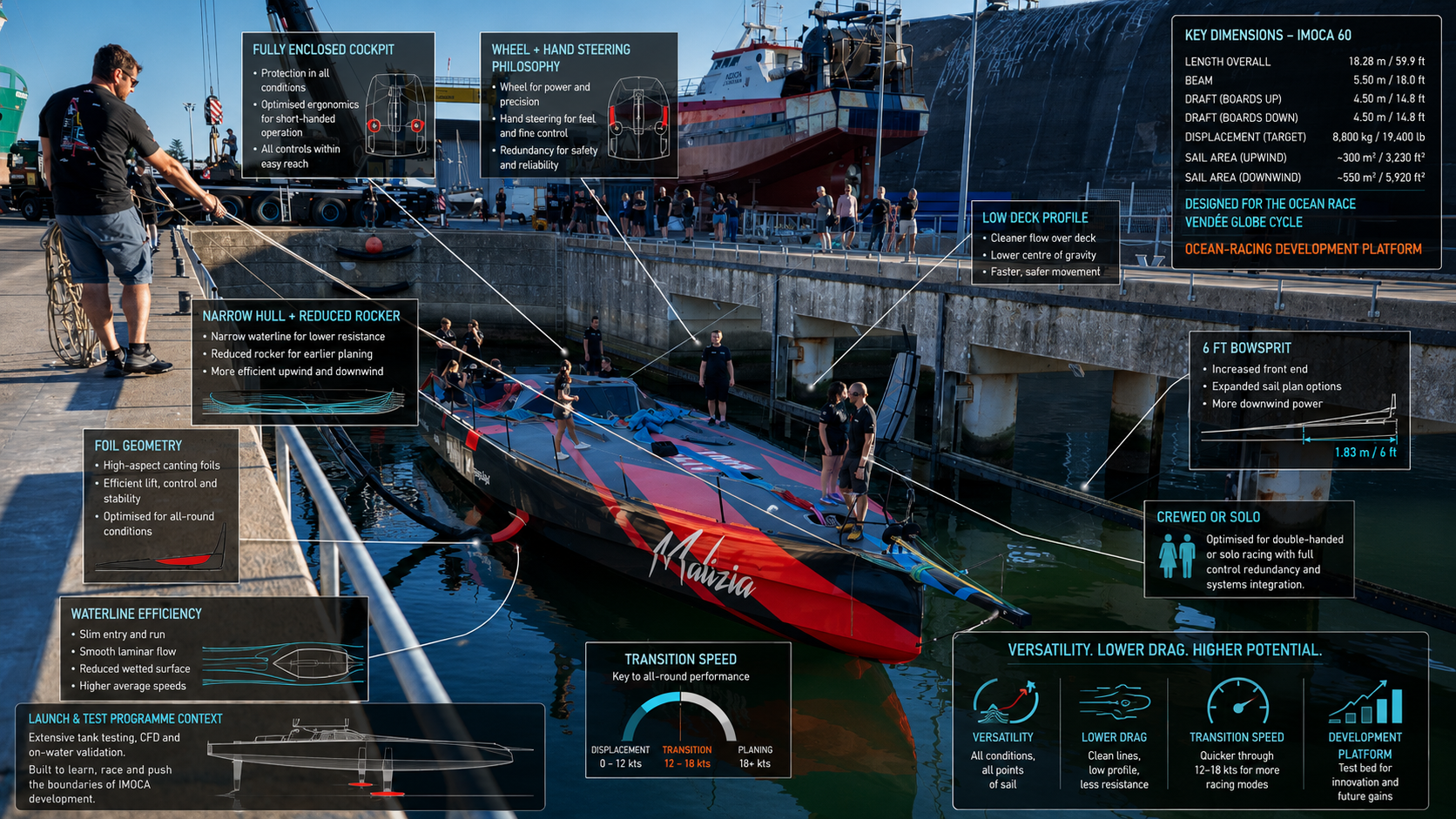
Malizia 4 was launched in Lorient on Monday morning after two years of design and construction, involving more than 150 people and more than 85,000 working hours. The boat is designed for the next chapter of Team Malizia’s programme: The Ocean Race Atlantic, the Route du Rhum, The Ocean Race 2027, and ultimately the Vendée Globe 2028-2029.
That schedule alone tells us a lot.
This boat is not being built for one perfect race in one perfect condition. It has to work crewed. It has to work solo. It has to cross the Atlantic in anger. It has to survive the Southern Ocean. It has to satisfy the demands of Boris Herrmann, Will Harris, the full Malizia crew, the shore team, the science programme, and the extremely cruel reality of modern IMOCA racing.
So let’s over-analyse it properly.
Because if we want to understand where IMOCA is going next, Malizia 4 is one of the boats we have to understand.
Building on success.
The first important thing to say is this:
Malizia – Seaexplorer was a great success
That boat was one of the most interesting IMOCAs of the previous generation. It had a very clear identity. It was big, powerful, full-bodied, and designed with the Southern Ocean very much in mind. It had a fuller bow, higher freeboard and significant rocker — that “banana boat” character that helped keep the bow out of the water in heavy waves. Yachting World’s detailed profile of the boat described how this volume and rocker helped the boat carry power and recover from wave impacts in brutal ocean conditions.
And it worked.
During The Ocean Race, Malizia – Seaexplorer produced some of the most spectacular monohull sailing we have ever seen. In Leg 5, during the North Atlantic speed-fest, the boat set a new 24-hour monohull record of 641.13 nautical miles, averaging 26.71 knots.
That is not a boat you step away from because it was bad. That is a boat you evolve from because it taught you something.
The previous Malizia was a Southern Ocean animal. It could keep the bow up. It could take punishment. It could keep driving when the sea state became ugly. It had a kind of heavy-weather authority that made it very dangerous when the conditions matched its strengths.
But every strength in yacht design has a price.
The same volume and rocker that helped Malizia – Seaexplorer survive and perform in big downwind conditions also came with penalties. More rocker and more volume can mean more drag, more windage, more wetted surface, and a boat that is not as sharp in light wind, flat water, transition zones, and marginal foiling conditions.
And that is the key to understanding Malizia 4.
The new boat is trying to take the best part of it — the ability to go hard offshore — and make it faster everywhere else.
The design brief: keep the beast, sharpen the knife
Boris Herrmann has described the new boat’s guiding idea very clearly: versatility.
That word sounds boring until you understand how brutal IMOCA racing is.
Versatility in this class does not mean being “okay” at everything. It means being able to remain genuinely dangerous through the full range of an ocean race. Heavy downwind Southern Ocean conditions. Light air transitions. Flat water. Upwind work. Reaching. Restarting after ridges. Escaping weather systems. Sailing crewed. Sailing solo. Hand steering. Autopilot sailing. Racing for one day, one week, one month, or around the world.
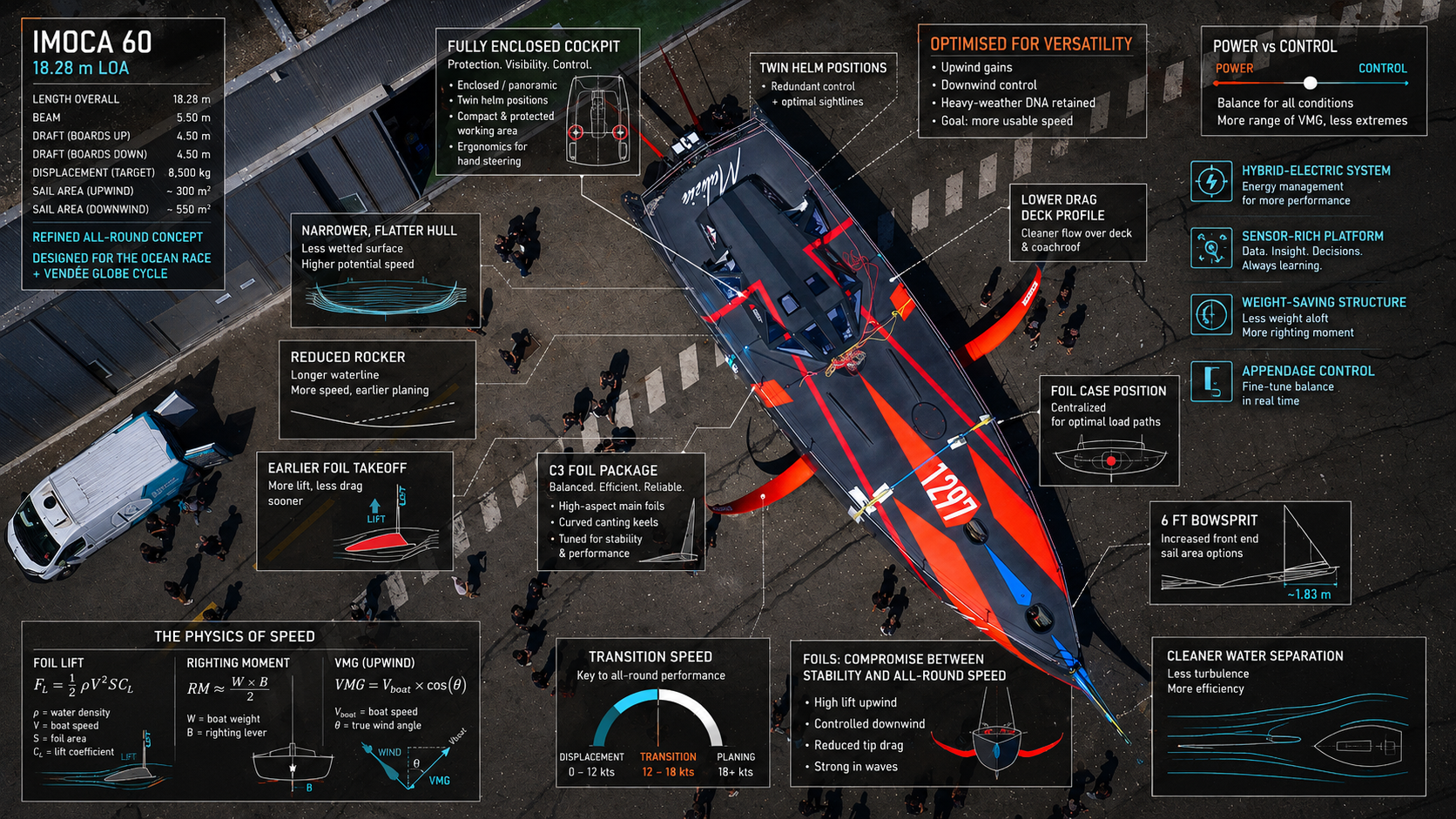
The team says Malizia 4 is designed to keep the previous boat’s heavy downwind performance while becoming faster upwind, faster in light winds, quicker through transitions, and able to fly earlier on powerful foils.
That is the whole story in one sentence.
And that is exactly where the IMOCA design war now seems to be heading. The question is no longer simply: who can build the fastest boat in ideal conditions?
The better question is:
Who can build the fastest boat that the sailor can actually keep fast for long enough to win?
Because in the Vendée Globe, theoretical speed means nothing if the skipper cannot use it. A boat that can do 35 knots in a perfect burst but has to be backed off constantly may lose to a boat that can sit at 90 percent for days and days while the skipper remains functional.
The ocean rewards usable performance. Malizia 4 is very clearly built around that idea.
The sistership project: three teams, one design family
One of the most interesting parts of the whole Malizia 4 story is that it is not a completely isolated design.
Team Malizia, Thomas Ruyant’s TR Racing, and Team Banque Populaire joined forces to co-design and build three new IMOCA sisterships. The project involves naval architect Antoine Koch, design office Finot-Conq, structural engineering firm GSea Design, and CDK Technologies as builder. The boats share a common design foundation, while each team can adapt details to its own skipper and programme.
That is unusual, and it is important.
IMOCA is usually a secretive world. Everyone is trying to find the tiny advantage nobody else has. But here, three top-level campaigns have accepted that collaboration may be more powerful than isolation.
Why?
Because modern IMOCA design is now so complex, expensive and risky that sharing knowledge makes sense. You reduce tooling costs. You reduce waste. You use the same mould. You build from collective experience. You can still customize systems, cockpit philosophy, energy choices, steering layout and skipper-specific preferences, but the deep platform is shared.
YACHT reported that the cooperation helped keep costs under control, and that Malizia’s technical director Pierre-François Dargnies said the new boat was not more expensive than the previous Malizia.
This is one of the quiet revolutions of the 2028 cycle.
The design war is not only about wild hull shapes. It is also about how teams organise themselves. It is about pooling resources intelligently, building faster, reducing carbon impact, and still arriving with a weapon that is specific enough to win.
The Thomas Ruyant boat was launched first. Malizia 4 is the second expression of this design family. Banque Populaire is expected to follow.
So when we look at Malizia 4, we are not only looking at Boris’s new boat.
We are looking at a whole design philosophy entering the water.
The hull: narrower, flatter, less rocker
The most obvious technical shift from Malizia – Seaexplorer to Malizia 4 is the hull.
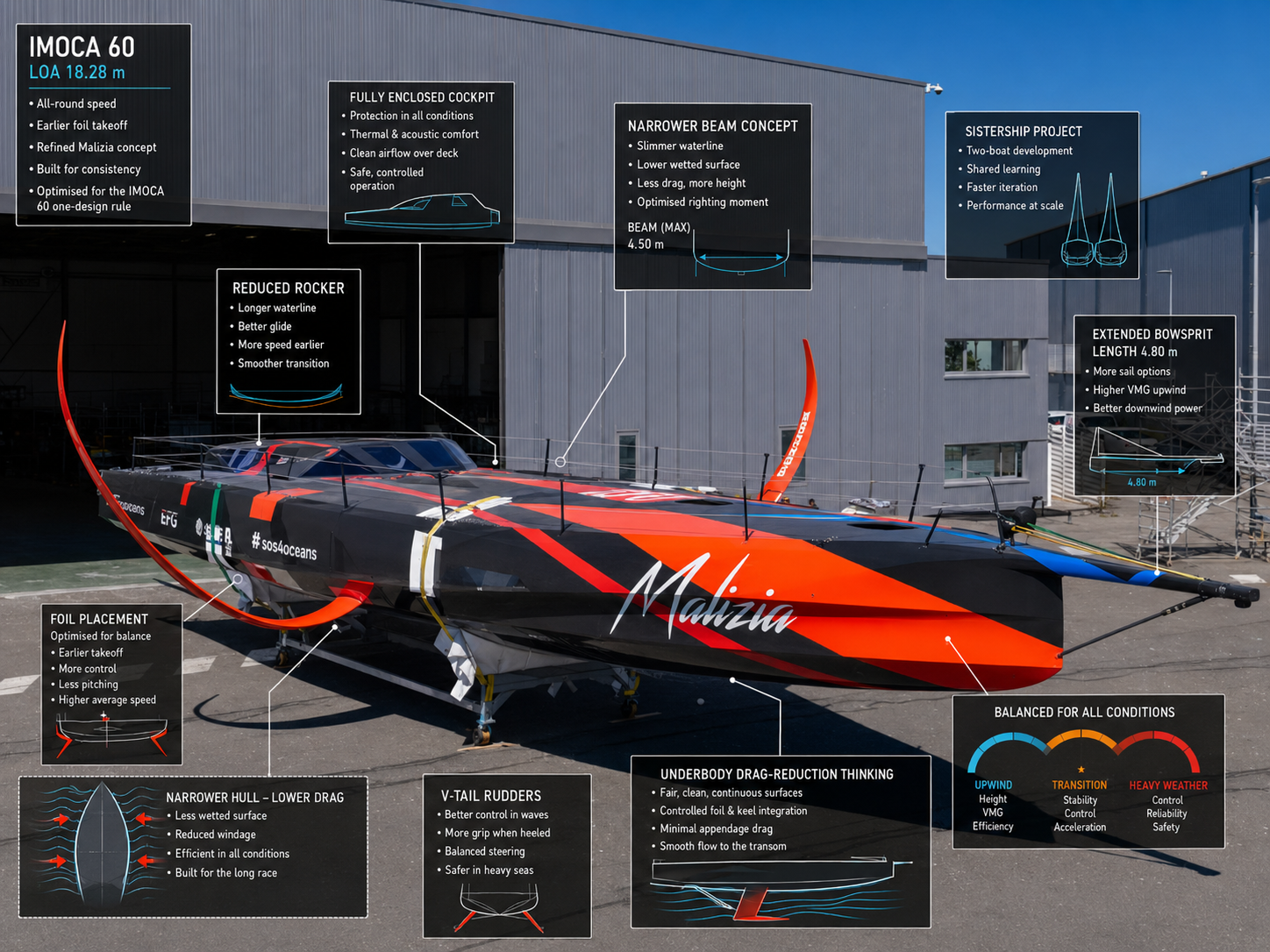
The new boat has a narrower, flatter hull with significantly less rocker than the previous Malizia. It remains an IMOCA 60, so the hull is 60 feet, or 18.23 metres, with a 6-foot bowsprit. As on the previous boat, Schütz CORMASTER honeycomb material is used in the hull and deck structures.
This is a major change in character. The old boat used volume and rocker as part of its survival and performance strategy. The new boat is slimmer, flatter, and more committed to earlier, cleaner, more efficient foiling.
YACHT reported that Malizia 4 is roughly a metre narrower than the previous boat, which had been close to the IMOCA maximum beam when launched. The team has not published an exact beam figure, but the change is visually obvious and strategically meaningful.
A metre narrower is not a styling choice.
That is a design statement.
The old boat was a whale. A powerful, muscular, Southern Ocean whale.
The new boat is more like a blade.
Less excess. Less volume. Less comfort. Less drag. More efficiency.
That does not mean it will automatically be faster in every condition. Nothing in IMOCA is that simple. But it tells us the direction of travel. Team Malizia seems to believe that the next step is not to build an even bigger, fuller, more brutal wave-crusher.
The next step was to reduce the penalty.
Keep the ability to go offshore hard, but make the boat lighter, sharper and more responsive in the conditions where the old boat had to work harder.
The blade: Malizia’s answer to the bustle
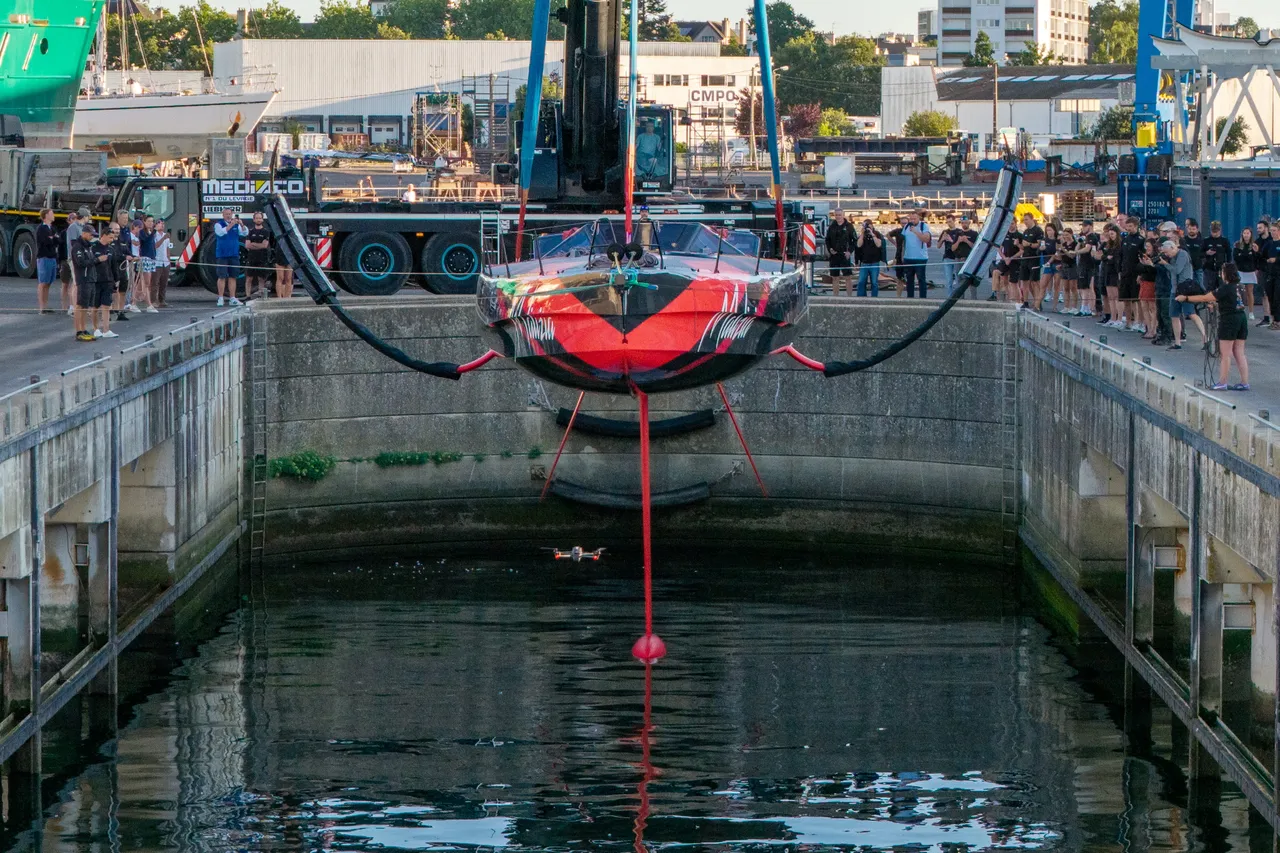
One of the most fascinating details on Malizia 4 is the blade along the underside of the hull.
This is one of those features that looks small from a distance but may tell us a lot about the thinking behind the boat.
Pierre-François Dargnies explained that the blade is intended to reduce wetted surface when the boat heels. It creates a boundary that helps the water separate cleanly from the hull, reducing drag.
A modern IMOCA is not simply sailing through the water like an old displacement yacht. It is constantly changing modes. Sometimes it is floating. Sometimes it is skimming. Sometimes it is half-flying. Sometimes the hull is touching just enough to create drag. Sometimes it slams down violently and then has to detach again.
So clean separation is the order of the day.
If water clings to the wrong parts of the hull, you pay for it in drag. If the hull can release more cleanly, you can reduce the penalty when the boat is heeled and partly supported by the foils. This is also where Malizia 4 becomes interesting in the wider design war.
DMG MORI Global One, designed by Guillaume Verdier, has gone for a much more radical hull approach, with a form compared to the central hull of a trimaran. That concept is intended to help the boat foil more easily, slam less violently, and reduce wetted surface and drag.
Malizia 4 does not go that far. It does not have the same dramatic central-hull / bustle concept. Instead, it uses the blade as a cleaner, possibly lighter, less extreme way of addressing water separation and wetted surface.
So this is the comparison:
DMG MORI asks: can we rethink the IMOCA hull almost like a foil-assisted monohull borrowing from multihull behaviour?
Malizia asks: can we refine the proven IMOCA language, reduce drag, save weight and improve flight without making the boat too exotic?
That is exactly why this generation is so exciting. The boats are not all converging on one obvious answer.
They are starting to disagree.
Foils: between the old C-shape and flatter all-round speed
The foils on Malizia 4 may be one of the most important parts of the entire boat.
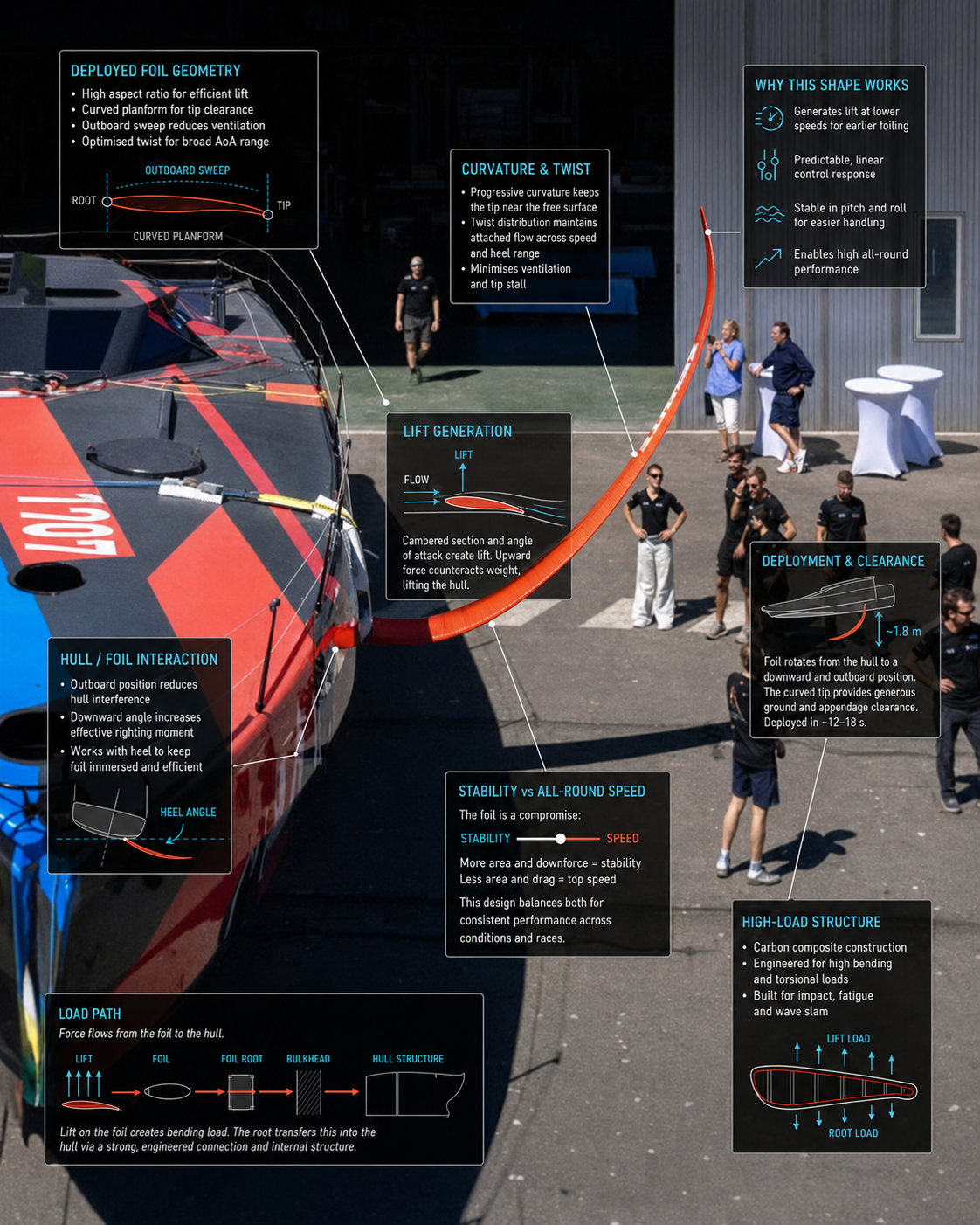
Team Malizia says the foils were designed to match the heavy downwind performance of Malizia – Seaexplorer while remaining competitive with boats such as MACIF in flat water and light winds. Built by C3 Technologies, their shape is described as a compromise between the previous C-shape foils and flatter designs that work better upwind and in transitions.
That is a wonderfully revealing sentence.
The previous Malizia’s C-shaped foils were not even originally the team’s intended race foils. They became famous partly because the original L-shaped foils were damaged before The Ocean Race, forcing the team onto replacement C-shaped foils. But according to Will Harris, that turned out to be a blessing: the C-shaped foils helped regulate the boat’s motion through waves, offered a more polyvalent character, and made the boat less prone to wild leaps.
So Malizia 4 does not simply throw that lesson away.
It takes the C-shape lesson — stability, regulation, heavy-weather confidence — and blends it with a flatter, faster, more transition-friendly direction.
The team is not trying to win the design war by pretending the last boat taught them nothing. They are trying to encode the lessons into the next machine.
And the MACIF reference is important as well.
Charlie Dalin’s MACIF Santé Prévoyance became the benchmark of all-round efficiency in the last Vendée Globe cycle. If Malizia can keep its old heavy-weather strength while moving closer to that kind of flat-water, light-wind and transition performance, then the new boat becomes very dangerous indeed.
Again, this is the theme:
Not the highest top speed, but the best average.
Not one perfect mode, but all-round usable speed.
V-tail rudders and the new trimming game
Malizia 4 also carries Monaco-red V-tail rudders, another visible evolution of the appendage package. Team Malizia describes them as being designed to improve trimming the boat.
This is part of a wider IMOCA trend: rudders are no longer simply steering devices.
On boats like this, everything is connected. Foils, rudders, ballast, sail plan, heel angle, pitch, flight height and autopilot all interact. A rudder configuration can influence not only steering, but also trim and the way the boat behaves when foil-assisted.
YACHT points out that V-rudder ideas have already appeared in the class, including with Charal 2, and that they can act as multi-purpose tools affecting trim and foiling behaviour.
This is a reminder that modern IMOCA design is not just about hull shape. It is about the entire dynamic system. A boat like Malizia 4 is not “a hull with sails.” It is a flying, trimming, self-monitoring, semi-autonomous, human-driven ocean machine.
The mast: heavier, stronger, one-design reality
Malizia 4 uses the IMOCA one-design rotating carbon mast supplied by Lorima. The Generation 2 mast stands 27 metres above deck, or 28.5 metres from the waterline to the top, and the complete mast, boom and rigging package is around 540 kilograms.
YACHT adds a nice detail: the bare mast weighs 320 kilograms and is reinforced with more carbon on the sides than the previous mast generation.
This is one of those hidden compromises in the class. Everyone wants lighter boats. Everyone wants to save kilograms everywhere. But some parts of the boat are getting heavier because the loads are becoming so extreme.
Boris himself noted that some components are heavier than before: the foils, the mast, the rudders and rudder fittings. So while the new boat is a little lighter overall, the weight-saving work has had to happen through intelligence and simplification rather than simply making every part lighter.
That is a very modern IMOCA problem. The boats are trying to become lighter and stronger at the same time. That is not easy.
The cockpit: where the biggest performance gain may be human
Now we get to what may be the most important part of the whole boat: the cockpit.
Malizia 4 has a fully enclosed cockpit with large panoramic windows, two winch tables with larger winches, a cleaner layout, and steering wheels instead of a tiller.
Boris Herrmann has said that if the goal is to win The Ocean Race, the team believes they need to hand steer — and that hand steering can bring a bigger gain than a new hull or foil shape.
We love talking about hulls, foils, CFD and exotic shapes. But Boris is basically saying: the biggest performance jump may come from the sailors. If the crew can steer more often, with better visibility, better shelter, better feel and less fatigue, then the boat can be driven harder.
At high IMOCA speeds, the difference between “fast” and “too much” is very small. A good helmsman needs feedback. The boat needs to be responsive. The cockpit has to let the sailor feel the machine without being destroyed by spray, cold, noise and impact.
That is why the steering wheels matter.
That is why the ergonomic layout matters.
The fastest boat is not the one with the best theoretical polar.
The fastest boat is the one the sailors can actually keep in the fast mode.
The spartan truth: comfort is gone
Now for the less glamorous side.
Malizia 4 is not comfortable.
The cockpit is less than a third the size of the generous working space on Malizia – Seaexplorer, and that Boris can only stand upright at the sides. The new arrangement is compact, low and efficiency-driven.
This is where the romance of the new boat becomes slightly brutal.
Yes, the black-and-red machine looks incredible from the outside. But inside, this is not a luxury yacht. It is a carbon survival cave designed around performance.
The old boat had more volume, more headroom and more living space. The new boat has accepted that much of that comfort was also weight, windage and inefficiency. In the new design, everything has to justify its existence.
The skipper is not being given comfort.
He is being given a weapon.
And then asked to survive inside it.
Malizia 4 has two bunks in the aft cabin, two more bunks near the cockpit side spaces, and the navigation station and computer area positioned close to the action. The sail locker is accessed through the side enclosed spaces. No images on specials seating or chairs yet, but we expect that will be coming at some point also.
This tells us how compact and integrated the boat has become. Living space is no longer separate from sailing space. The whole interior is part of the cockpit system.
The invisible boat: sensors, AI and data
One of the easiest things to miss is that Malizia 4 is not only a carbon object.
It is also a data machine.
The boat uses ifm sensors for real-time monitoring of key systems, including pressure sensors for ballast tank levels and radar sensors to monitor flying height and attitude while foiling. B&G provides electronics, Pixel sur Mer is involved in the autopilot, and SEA.AI uses artificial intelligence, optical cameras and thermal imaging to help detect floating hazards before collisions. The boat also carries more than one kilometre of onboard cabling.
Modern IMOCA sailing has become almost aerospace-like. The skipper is not just sailing by feel. The boat is constantly measured. Ballast, flight height, attitude, energy, autopilot behaviour, weather data, routing and performance modes all become part of the decision system. And it matters because the sailor is alone, exhausted, wet and operating at the edge of what a human can process.
Data does not replace seamanship, but it changes the battlefield.
The sailor who understands the boat better can push harder. The shore team that learns faster can improve settings. The autopilot that behaves better can keep speed when the skipper sleeps.
Hybrid power, hydrogeneration and the science mission
Malizia 4 continues Team Malizia’s long-running identity as both a racing campaign and a science/climate platform.
The boat uses an optimized hybrid-electric propulsion and energy system, with a Molabo electric motor, Fischer Panda generator and Solid State Marine batteries. The engine is used for harbour manoeuvres, safety and charging when renewable sources such as hydrogeneration are not enough.
The boat will also continue Team Malizia’s OceanPack work, collecting ocean data such as sea surface CO₂, temperature and salinity during races and deliveries, including in remote areas where scientific data is scarce.
This is part of why Boris Herrmann has such a unique position in the class.
He is not only popular because he is a strong sailor. He has built a whole identity around elite sport, ocean science, education, and climate messaging. The boat carries the UN Sustainable Development Goals wheel and Team Malizia’s “A Race We Must Win – Climate Action Now” message rather than acting as a simple single-brand billboard.
And then there is the wonderful new hull question:
“What’s under your boat?”
That line is an ode to a question oceanographer Sylvia Earle once asked Boris Herrmann, and it connects the racing boat back to the science mission and Boris’s wider ocean storytelling.
That is very Malizia.
Even on a hardcore racing machine, there is still a message.
Where Malizia 4 fits in the new IMOCA design war
So where does Malizia 4 sit in the new IMOCA landscape?
I would not call it the most radical boat.
That title probably belongs to DMG MORI Global One, with its Verdier-designed central hull concept and dramatic attempt to reduce wetted surface, reduce slamming and foil earlier through a more trimaran-like interpretation of the IMOCA hull.
I would also not call Malizia 4 a conservative boat.
It is too narrow, too sharp, too optimized and too different from the previous Malizia for that. Instead, Malizia 4 feels like a very serious evolutionary weapon.
It takes the lessons from Malizia – Seaexplorer, combines them with the shared Koch / Finot-Conq / GSea / CDK sistership programme, and aims for the most difficult thing in IMOCA: a boat that is fast everywhere.
Heavy downwind? Keep the Malizia DNA.
Light wind? Reduce the penalty.
Transitions? Fly earlier.
Flat water? Chase MACIF-style efficiency.
Crewed racing? Build steering and ergonomics for hand-driven speed.
Solo racing? Keep the cockpit protected and the systems manageable.
Ocean science? Continue the Malizia mission.
It is a very ambitious list. And that is why the boat will be fascinating to watch.
The danger: all-round boats are hard to perfect
One important caution.
When a design aims to be good everywhere, there is always a risk that it becomes brilliant nowhere. That is the eternal danger of versatility.
A specialized heavy-weather boat can dominate in its favourite conditions. A flat-water rocket can destroy the fleet when the angle and sea state match. A radical design can change the rules if the conditions reward its strongest mode.
But an all-round boat has to be judged over time.
It has to prove that the compromises really add up. It has to show that it did not give away too much of the old Malizia strength in exchange for light-air and transition speed. It has to prove that the narrow hull is not too unforgiving, that the cockpit works offshore, that the blade really helps, that the foils deliver the intended balance, and that the boat can be learned quickly enough.
Malizia 4 has a brutal early calendar.
The team plans to use every opportunity to sail and train before delivery to New York in mid-August. The first major race will be The Ocean Race Atlantic, starting from New York to Lorient on 1 September, followed by Boris taking on the Route du Rhum solo. After that come The Ocean Race 2027 and the Vendée Globe 2028-2029.
That is not much time. A new IMOCA is never truly finished at launch. It is born at launch.
Then the team has to raise it at sea.
The real question
So what is Malizia 4?
It is not just the new Boris boat. It is a statement about what Team Malizia believes the next generation requires. It says that the last boat’s Southern Ocean power was real, but not enough. It says that IMOCA speed is moving toward earlier flight, cleaner transitions, lower drag and better all-round efficiency. It says that cockpit design and hand-steering may matter as much as hull and foil theory. It says that weight discipline is now a full-boat philosophy. It says that the future IMOCA is not just carbon and sails, but sensors, autopilots, AI cameras, science systems and human ergonomics.
Most importantly, it says that the next Vendée Globe may be won not by the boat with the most extreme single idea, but by the boat that connects all its ideas into one usable system.
Final thought: the pretty boat has teeth
Boris Herrmann is popular. That is obvious.
He is one of the few IMOCA skippers who can bring in the casual sailing audience, the climate audience, the German mainstream audience, and the serious offshore nerds all at once. He is a media asset, a sailor, a science ambassador and, yes, a bit of a class celebrity.
But Malizia 4 should not be underestimated because the campaign is polished.
This is not just a nice-looking black-and-red boat for the cameras.
It is a highly calculated response to years of hard ocean lessons. It is narrower, flatter, more spartan and more focused. It has the blade under the hull, new compromise foils, V-tail rudders, a more aggressive cockpit philosophy, serious data systems and a programme that will test it almost immediately.
The old Malizia proved Team Malizia could build a Southern Ocean monster.
The new Malizia is asking a harder question:
Can they build a monster that is dangerous everywhere?
The Atlantic will answer first.
The Route du Rhum will answer harder.
And the Vendée Globe 2028-2029 will tell us whether this black-and-red weapon was simply beautiful — or whether it was one of the boats that helped define the next era of IMOCA sailing.
By Florian Rooz (editor)